

Hello and welcome back to my blog. I’m going to start focusing on individuals I find interesting as I explore and am source indexing. Please come along for the ride, if you feel you’d like to come on a journey. Because I have a huge project in building now for about 5 months, and I think maybe I should keep up in between as well.
I’m starting with an ancestor newly found today that someone else attached, and obviously broke through a brick wall. I love when walls come down. Yes. Please.
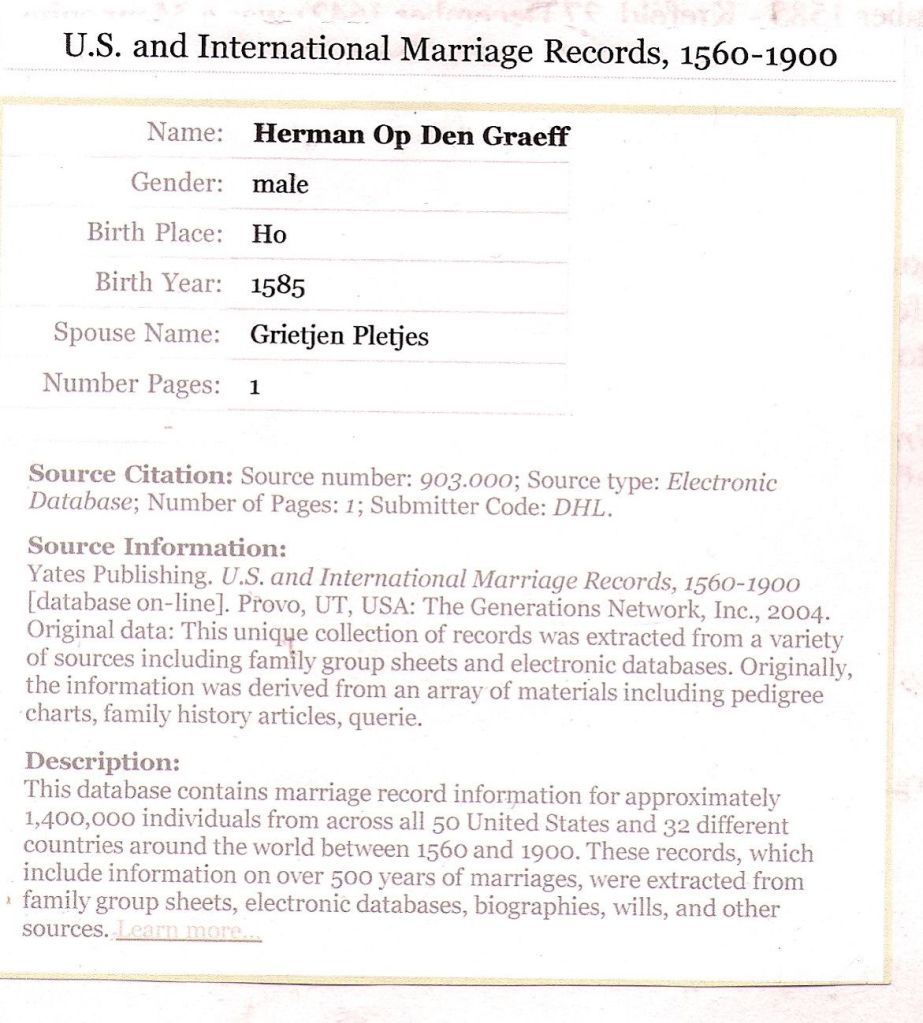
Much of this information which I found to be from Wikipedia, and attached to my family tree.
Name:
Bishop Herman op den Graeff
Herman op den Graeff, also Hermann (Aldekerk, 26 November 1585 – Krefeld, 27 December 1642) was a Mennonite community leader from Krefeld.
Biography
Origin
Herman op den Graeff was the first historically proven member of the Op den Graeff family. He was born on 26 November 1585 into a Mennonite religious family in Aldekerk (Duchy of Guelders, Holy Roman Empire), near the Dutch border.
Early years
In 1605, Herman op den Graeff removed to Kempen where he met and married Greitgen Pletjes (or Greitje Pletjes) on 6 August 1605. In 1609 the family moved to Krefeld.
Krefeld Mennonite Church
Op den Graeff windows
Un Krefeld, Op den Graeff became a lay preacher and leader of the Mennonite community. In 1630, he had two stained glass windows (Op den Graeff windows) with paintings and religious aphorisms created for himself and his wife Greitgen (Greitje) Pletjes as a sign of his piety. The windows originally where located at Op den Graeffs house at Krefeld. During the 19th century the window where located at the Kaiser-Wilhelm Museum at Krefeld and were apparently transferred to the Linn Castle, also at Krefeld. The windows were stolen from the Linn Castle during the chaos of the end of the Second World War and no longer correspond to the description given before the theft. The current window contains a depiction of the Virgin Mary, which would have been unthinkable for a Mennonite. At this point there was another saying, the text of which has been handed down.
Following is the reproduction of both texts, in original German language and Translated english language, according to the line structure of the copy that was received:
Gott fruchtigh from und gutt von senden, Luistigh frundtlich und war von reden. Ist christlich und gefalt den Herren. Bringt gunst und setzet menneger zu grosser ehren. Herman op Den Graff und Greitgen sein hosfrow. A 1630
and the translated English version:
God is fruitful, devout and good to all sides, talked cheerfully and Kind. I am christian and appeal to the Lord. I bring affection, and one grants great honor to me. Herman op Den Graff and Greitgen his wife. Anno 1630
Disappeared text (glass plate replaced by depiction of the Virgin Mary) in original German language:
Wer wyl uns scheyden von der liebe gottes, Truebsal oder angst oder verfolgung oder Ferligkeyt oder Schwert? Wie geschrieben steht um Deinen willen werden wir getoedtet den gantzen tag. Wir siendt geachtet fur Schlachtschaaffe. Aber in dem allen ueberwinden wir weit um des willen, der uns geliebet hatt. Roem. 8 c 35 v
and the translated English version:
Who will take from us God’s love, sorrow or fear or persecution or execution or sword? As written in your will, we are being destroyed all day long. We are looked upon as sheep to be slaughtered. But we overcome all for the one will who has loved us. Romans Chapter 8, Verse 35
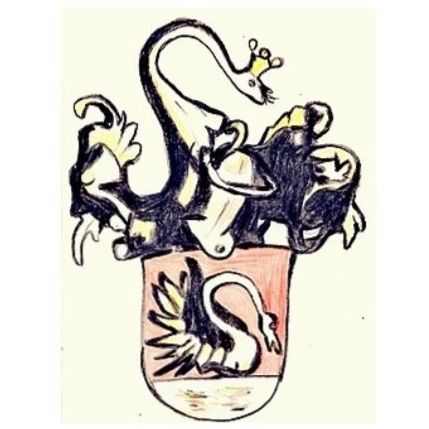
Possible, but not proven coat of arms Op den Graeff as descendants of Herman op den Graeff (Heraldic representation by Matthias Laurenz Gräff based on the Krefeld Op den Graeff stained glass window from 1630, which may depict the “Lohengrin swan” of the Kleve coat of arms in one window)
Coat of arms
There is a reference about the Op den Graeff glass paintings of Krefeld with a description of Hermans possible, but bot proven Coat of Arms was found in the estate of W. Niepoth (op den Graeff folder) in the archives of the city of Krefeld, who noted a letter dated November 17, 1935 from Richard Wolfferts to Dr Risler: Saw the Coat of Arms glass pane in the old museum: ‘Herman op den Graeff und Grietgen syn housfrau’ or the like. Coat of Arms – In the sign a silver swan in blue. Helmet decoration (I think): Swan growing.
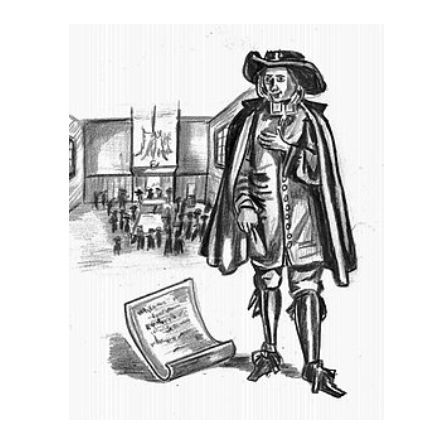
Herman op den Graeff in front of the 1632 Dordrecht Mennonite Church Delegation and as a signer of the Dordrecht Confession of Faith
Activity as a Mennonite leader
Herman op den Graeff in front of the 1632 Dordrecht Mennonite Church Delegation and as a signer of the Dordrecht Confession of Faith.
In 1632, Herman op den Graeff was one of two Krefeld Mennonite Church delegates to sign the Dordrecht Confession of Faith. In Krefeld he worked as a preacher in the Mennonite community. In 1637, he was named as the “der hiesigen Mennoniten Herrn Bischof” of Krefeld (Mennonite lord bishop of Krefeld). A Reformed member complained bitterly about the activity of Op den Graeff that “some ordinary non-Mennonites were attracted.” In 1637 donations were requested for the suppressed Reformed Church in Sweebrucke, and Op den Graeff donated the sum of 25 Reichsthaler from his own resources on behalf of the small Krefeld community, while the Reformed community in Krefeld only contributed 22.
Descendants
On August 6, 1605 Herman op den Graeff married to Greitgen (Greitje) Pletjes (1588–1643).
They had the following children:
1.) Trinken (Dinken) op den Graeff (1607–~1608)
2.) Hester op den Graeff (~1609–1657), married around 1627 to Isaac Van Bibber (Van Bebber) (died 1705)
3.) Abraham op den Graeff (~1610–1656), married to Eva von der Leyen
4.) Herman op den Graeff (1647-1695), married to Hester van Bebber and Catherine Laments Vonder Pypen
5.) Trinken op den Graeff (1612–~1658)
6.) Hallerkin (Hillekin?) op den Graeff (~1614–~1691), married around 1635 Theissen Matthias Doerrs (Doors)
7.) Isaac (Hermans) op den Graeff (February 28, 1616 – January 16, 1679), married Margaret Peters Doerrs (Margaretha ‘Grietgen’ Doors) (1621 –November 11, 1683), in 1683 their descendants migrated to Pennsylvania, United States
8.) Jacob op den Graeff (~1617–~1618)
9.) Alletjen op den Graeff (1619–1619)
10.) child (1620–1620)
11.) Dirck (Derek) op den Graeff (1621–~1655)
12.) daughter (1622–1622)
13.) Alletjen op den Graeff
14.) Andreas op den Graeff (1625–)
15.) Fricken (Frinken) op den Graeff
16.) Susanna op den Graeff (~1629–~1714)
17.) Andreas op den Graeff (1631–)
18.) Jacob op den Graeff (1634–1634)
In 1683, three of Herman op den Graeff’s grandchildren (children of Isaac Hermans op den Graeff), Derick, Herman and Abraham op den Graeff, who where cousins of Pennsylvania founder William Penn as well, migrated to Pennsylvania, United States. They are among the thirteen families, Original 13, the first organized immigration of a closed group of Germans to America, who arrived on the ship Concord on October 6 that year. They often referred to as the Germantown, Philadelphia, Pennsylvania founders. Later Pennsylvania Governor Samuel Whitaker Pennypacker was Herman’s sixth-great-grandson through Abraham op den Graeff.
MORE INFORMATION
Biography
Herman was born of Mennonite parents in the village of Aldekerk, Germany on 26 Nov 1585.
In 1615 in Krefeld (about 12 miles from Aldekerk) he wed a Mennonite girl named Greitijen Driessen (often seen as Grietjen Pletjes) of Kempen, a small town between Aldekerk and Krefeld.She was the daughter of Pletjes Driessen of Kempen. The date 16 Aug 1605 was given for the marriage on this profile, but a source is needed for this date since it does not concur with the year 1615 given in two previously cited sources. The marriage date on the profile has been changed to 1615.
Herman was a linen weaver and a cloth and linen merchant.
Herman Opden Graeff was a delegate to the Mennonite Conference, held in the city of Dortrecht on April 21st, A. D. 1632; and signed the Eighteen Articles of Faith of the Mennonite Church. He was a father to eighteen children, one of whom, named Isaac, had four children, three sons and one daughter named Margaretta. This is the family that settled early in Germantown.
Herman died 27 December 1642, leaving his widow and eighteen children. His widow would die the next year.
Their son Isack Hermans Op den Graeff would marry and convert to Quakerism. After he passed in 1679, his family would sail aboard the ship “Concord” to Philadelphia arriving in October 1683.
And that brings me to where I am, in America and below you will find my relation and how. He is my 13th paternal great grandfather.
One reason I picked him is he was a Bishop, and when I read Mennonite, it reminded me of a fond memory I have with my son where we sang on the side street together in public with a group of Mennonites that were singing. Everyone was happy, smiling, laughing, and it felt good to feel the positive vibes. Also it seems he was a good fellow, and I have another related post called Martyr’s, Monk’s, Saint’s and Mayhem, so I thought this would fit well.

There is a book in pdf form I found that is interesting and a reliable source. I can’t share other documents because some are sensitive, and copyrighted, but are attached to his profile. Click the book cover below to download and read the pdf or just open and read.
-Dawn Piercy, PhD
 DP Family Tree